


President Biden and Vice President Kamala Harris signed into law a bill establishing Juneteenth National Independence Day, a celebration designating the end of slavery in the United States, as a federal holiday.
In 1865, the last enslaved African Americans in Galveston, Texas, were finally notified that the Civil War was over and they were free. The news came more than two years after President Lincoln signed the Emancipation Proclamation granting freedom to all slaves in the Confederate states.
Since that day, Juneteenth has become a time to both remember the country’s history of slavery and to celebrate Black independence. Still, some states recognize different dates of emancipation. In Florida, advocates are pushing for the state to recognize May 20 as Emancipation Day, when the news reached enslaved African Americans in that state.
“By making Juneteenth a federal holiday, all Americans can feel the power of this day and learn from our history, and celebrate progress, and grapple with the distance we’ve come but the distance we have to travel to,” Biden said during remarks Thursday in the East Room of the White House. The last federal holiday was created in 1983 when former President Ronald Reagan established Martin Luther King Jr. Day.
“Great nations don’t walk away,” Biden added. “We come to terms with the mistakes we’ve made.”

The law takes effect immediately and will be celebrated on Friday, June 18, since it is the closest weekday.
The bill faced only slight opposition in the House of Representatives earlier this week from some Republicans who cast the measure as racially divisive. Despite protests, only 14 members of the House GOP caucus voted against the legislation. The bill passed unanimously in the Senate.
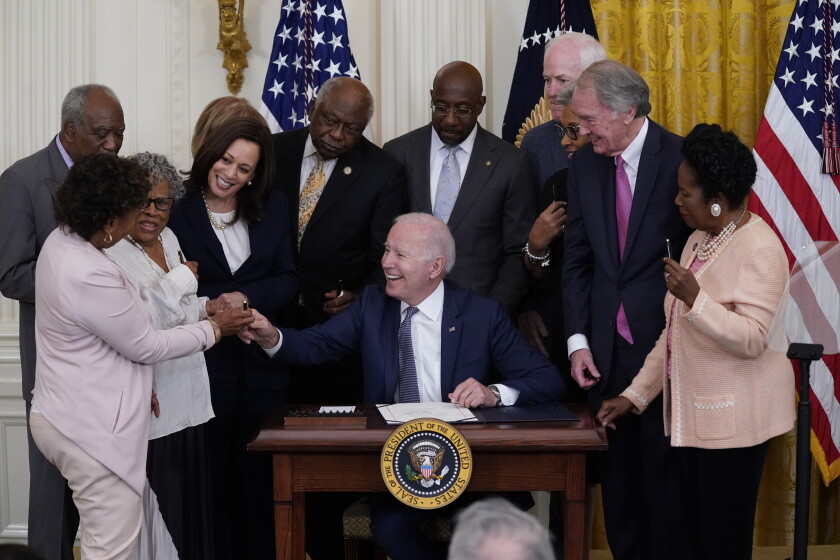
“We are gathered here in a house built by enslaved people,” said Harris, who signed the bill in her capacity as president of the Senate. “We are footsteps away from where President Abraham Lincoln signed the Emancipation Proclamation. And we are here to witness President Joe Biden establish Juneteenth as a national holiday.”
During the debate on the House floor, before the bill passed, several members of the Congressional Black Caucus defended the legislation against Republicans who took issue with the bill. Rep. Brenda Lawrence, D-Mich., a vice chair of the CBC, refuted Republican Rep. Clay Higgins’s claim that Juneteenth “co-opted” Independence Day. Higgins, R-La., ultimately voted for the bill.
